Why use a drone for agriculture?
Next-generation farming.
Accuracy Agriculture Is A Game Changer
For centuries, farmers have actually strolled their areas keeping an eye on the health of their plants. It is a time-consuming procedure. But this is altering.
Farming drones are coming to be an essential vehicle driver to assisting farmers boost crop manufacturing, display and examine crop growth, build a richer picture of their areas, enhance farming performance, as well as maximise outcomes.
Amongst the many advantages, drone information can be utilized to remove soil characteristics - including temperature levels, dampness, and also elevation - which assists extra accurate dirt tasting.
Drones and also their advanced sensors can assist farmers strategy and troubleshoot irrigation systems, assisting with water circulation management and also usage; monitor plant emergence and population to drive replanting choices as well as enhance crop models; and also determine harvest strategies by aiding farmers expect a harvest's high quality as well as last return.
On-demand as well as high-resolution drone information is additionally ideal for recording as well as accurately reporting events that result in financial loss, like crop injury and also reduced health.
Drones cover locations quicker, use real-time understandings, are a lot more accurate than typical methods, as well as are non-evasive to crops.
Essentially, drones provide crucial information which aids farmers and cultivators check, intend and handle their farms more effectively - conserving time and money at the same time.
Approximately 100 acres
covered in a functioning day with a drone when the fields are close with each other.
85% reduced planting prices
when making use of 3D field mapping and soil evaluation with drones.
$ 1.3 billion every year
might be conserved by corn, soybean, and wheat farmers by using drones, states one research.
$ 4.8 billion
is the forecasted number that the agricultural drone market will grow to by 2024.
How Can Drones Be Utilized In Agriculture?
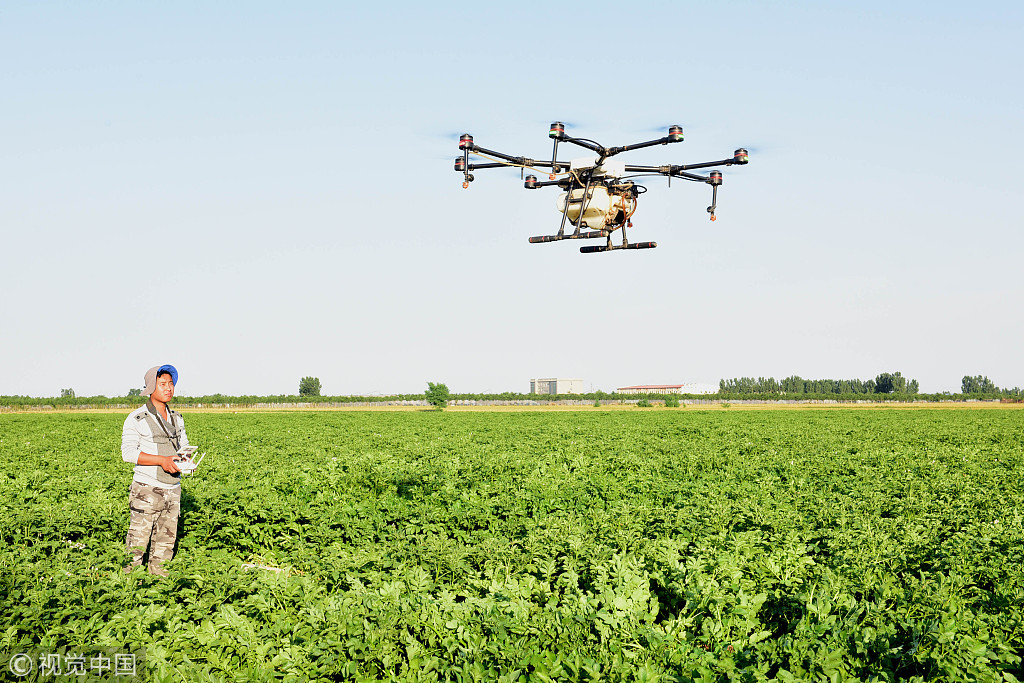
The versatility of drones and their advanced sensing units makes it possible for farmers to use the technology for a number of reasons. These include:
Plant Tracking: Drones monitor crops properly and also a lot more cheaply than standard methods and provide vital understandings right into plant advancement, along with highlighting ineffective and inadequate methods.
Soil and Area Evaluation: Drones can create 3D maps, swiftly and cheaply, which assist farmers make important choices concerning seed-planting pattern layout and nitrogen-level monitoring, for example.
Health Evaluation: Drones can record multispectral information to aid farmers gather vital understandings into plant wellness. Such very early treatment is important to correct any kind of issues.
Watering: Drones equipped with monitoring tools can identify areas of a field experiencing hydric stress and anxiety (lack of water). Thermal sensing units provide vital details, allowing targeted medical diagnosis of areas receiving excessive or inadequate water.
Aerial Growing: Drones can fly over a possible planting zone to check the best locations for development. They can then drop biodegradable vessels, loaded with seed and also nutrients, right into the ground.
Herd Monitoring: Farmers are releasing drones to keep an eye on livestock. Sometimes, drones with speakers, like the DJI Mavic 2 Enterprise Series, are utilized for pet movement, playing a pre-recorded pet dog bark. Farmers state this technique places much less stress and anxiety on the herd.
Plant Spraying: Crops can cover large areas promptly, using fluids with wonderful precision.
Insurance coverage: Drones can play a crucial duty in insurance coverage, at both the pre-and-post-claim phase. Making use of a drone helps for site assessment, declares choices, scams avoidance, and also threat administration.
" A few of my professionals have actually informed me that it is practically like using the drone is a sort of joining force in the partnership in between them as well as the farmer. The farmer likes it that they are below and making use of something so exact and cutting edge on their areas."
Philippe Vayssac, Groupama Rhone-Alpes Auvergne
" There is a substantial appetite for drones in agriculture as well as farming. A drone can be become an useful farming device-- flying it over a field to offer a farmer useful insights as well as a range of info, and making walking areas a thing of the past."
Jack Wrangham, Drone AG
PLANT SPRAYING DRONES
Automated, targeted and also precise.
A risk-free and also efficient option
Agricultural drone splashing is ending up being a significantly preferred application, helping to preserve plant health and wellness and returns.
Drones are being deployed for spraying for condition, weed, as well as insect control, in addition to spreading chemicals as well as fertilizers.
Using drones for this application makes sense, supplying a fully-automated, targeted as well as specific remedy, as well as changing labour-intensive, taxing, as well as possibly dangerous use of backpack sprayers and other devices.
This approach is particularly valuable in locations where the surface is undulating, steep, or tough to access.
Releasing a drone is likewise a less expensive alternative than using crop http://www.bbc.co.uk/search?q=ΓΕΩΡΓΙΚΑ DRONES dusters to spray areas too large for manual work.
Plant spraying drones are particularly common in China, where federal government aids advertise making use of farming drones. Leading drone producer DJI has replied to this demand by crafting the Agras spraying drones. There are currently more than 40,000 energetic Agras on the marketplace.
Spraying drones are not presently legal in the UK, however trials are being carried out ΨΕΚΑΣΤΙΚΑ DRONES to attempt to transform this. Much of these tests are based around bracken development on unattainable hillsides in upland locations crucial for lamb production. The goal is to construct a profile of evidence to highlight the positive uses crop-spraying drones and also encourage decision-makers to enable drone splashing.
" We have been spraying creeping plants in Switzerland making use of DJI Agras as well as our client is happy with the outcomes of drone splashing. Contrasting it to tractor splashing, he says the benefits of using the drone is no individual contact with pesticides, no phytotoxicity, and also in locations of steep terrain the drone has much higher performance."
Ueli Sager, Remote Vision
" Utilizing drones to spray pesticides is extra reliable than using tractors and is a reliable option for plant defense. First off, tractors damage the cotton when travelling through, while drones stop the cotton from being crushed. Initially, farmers had questions concerning drones, but after that they witnessed the airplane's effectiveness."
Yuhuan Li, Agricultural Drone Pilot
DJI Agras Plant Spraying Drones
Sophisticated farming spraying drones, the DJI Agras series is made to raise efficiency as well as manageability of plant defense and also fertilisation.
As an example, the T30 drone has a 30L operation tank, features 16 sprayers as well as has a 9m splashing size. The drone is capable of covering 16 hectares per hr. It also has a 30kg spreading tank, with 7m dispersing width, and also is capable of spreading out 1 ton of fertilizer per hr.
Meanwhile, the Agras T16 features a 16L spray container as well as is able to spray 24.7 acres (10 hectares) per hour. This is much faster than manual splashing methods.
The Agras collection can be released for a fully-automated, targeted, and specific spraying option, allowing contemporary farms to save money on labour while increasing protection and also outcomes.
For boosted effectiveness, the Agras collection can be made use of for swarming. As much as five Agras T16 drones can be regulated by a solitary T16 remote controller, while one Agras MG-1P controller can control as much as 5 MG-1P airplane concurrently - doubling the effectiveness of single-pilot procedures.